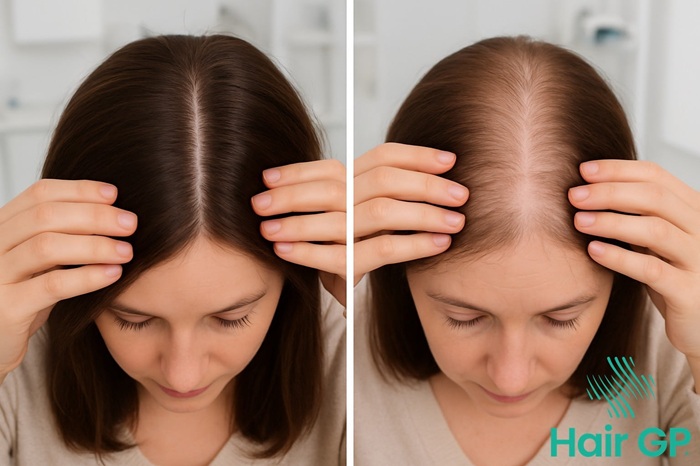
That first moment when you notice more strands on your pillow or see extra scalp in a photo can be genuinely unsettling. Many women assume hair loss is something that mainly affects men, yet thinning and shedding are far more common in women than most people realise. In fact, almost half of women experience some degree of hair loss during their lifetime, and for many, it arrives gradually rather than all at once.
The good news is that women’s hair loss treatment options today are far more advanced and discreet than they once were. From immediate cosmetic solutions to longer-term supportive therapies, the key is understanding what actually works at different stages of hair loss and choosing an option that fits your lifestyle, expectations, and level of thinning.
How women’s hair loss actually happens
Hair loss in women often develops quietly. It might begin with a widening part, reduced volume through the crown, or a ponytail that feels thinner than it used to. Hormonal changes play a significant role, particularly during menopause when oestrogen levels decline. Conditions such as PCOS, thyroid imbalance, postpartum changes, and chronic stress can also disrupt the hair growth cycle.
Female pattern hair loss, the most common cause of thinning in women, typically affects the top and crown of the scalp rather than the hairline. According to clinical research, this form of hair loss affects a substantial number of Australian women and is associated with significant emotional and psychological impact, particularly when it progresses beyond early thinning.
Understanding where and how your hair is thinning is essential, as different treatments work best at different stages.
Instant coverage options for early thinning
When thinning is mild, many women start with cosmetic coverage. Hair fibres are one of the most popular options at this stage. These microscopic fibres cling to existing hair using static charge, creating the appearance of thicker, fuller coverage in sparse areas.
High-quality fibres blend naturally, hold through humidity, and are particularly effective under office lighting or for social events. Lower-quality versions can look dusty or wash away easily, so product choice matters. While fibres do not treat hair loss itself, they can restore confidence quickly and are often used alongside longer-term solutions.
Crown extensions and topettes
Crown thinning is one of the hardest areas to disguise, especially under downlights or in photos. This is where topettes and crown extensions can be highly effective. These partial hairpieces cover only the thinning area, allowing you to keep your natural hairline and length.
Modern topettes are lightweight and often made from real human hair, meaning they can be washed, styled, and blended seamlessly with your own hair. They clip or bond onto existing hair, making them suitable for women with moderate thinning who still have enough hair to anchor the piece securely.
While more of an investment than cosmetic fibres, topettes are significantly less costly and less involved than full hair systems.
Does laser hair therapy work for women?
Laser hair therapy is often marketed as a regrowth solution, but its effectiveness depends heavily on timing. This women’s hair loss treatment works by stimulating follicles that are still active, improving scalp circulation and supporting the growth phase of the hair cycle.
Laser therapy does not revive follicles that have stopped producing hair entirely, but it can help strengthen existing hair, slow further thinning, and improve overall hair quality when used consistently. Results are gradual, often taking several months, and are typically more noticeable in early-stage hair loss.
Because laser therapy operates within a narrow biological window, it tends to work best when guided by a specialist rather than used as a standalone, at-home experiment.
Hair systems vs traditional wigs
For women experiencing more advanced thinning, coverage solutions often provide the most reliable results. Modern hair systems are very different from the obvious wigs of the past. These systems use ultra-thin bases that allow scalp colour to show through, creating a natural appearance even at close range.
Each strand of hair is hand-tied to mimic natural growth patterns, and the system is bonded securely so it can be worn during sleep, exercise, and daily activities. Maintenance involves regular appointments for cleaning and reattachment, with systems typically lasting six to twelve months depending on care.
Traditional wigs have also evolved significantly. High-quality wigs now feature hand-tied caps, realistic hairlines, and natural movement. They are removable rather than bonded, which some women prefer for flexibility. The trade-off is maintenance, as wigs require careful washing, drying, and storage to maintain their appearance.
When thinning shows through styling
For some women, hair loss reaches a point where styling alone no longer disguises thinning. In these cases, an integrated women’s hair loss treatment focuses on restoring visible density rather than attempting to stimulate regrowth that may no longer be possible.
Integrated systems sit flat against the scalp and move naturally with the head, providing consistent coverage without daily removal. Because they are designed to blend with remaining hair, they offer a balance between realism, security, and day-to-day comfort.
The emotional side of hair loss
Hair loss is not purely a cosmetic issue. Research consistently shows that alopecia in women is associated with reduced quality of life, increased anxiety, and challenges in social and professional settings. Studies indicate that many women attribute relationship strain and career difficulties directly to their hair loss experience, highlighting the importance of addressing both appearance and emotional wellbeing.
Recognising hair loss early and exploring options proactively can make a significant difference in how manageable the experience feels over time.
Finding what works for you
There is no single solution that suits everyone. Lifestyle plays a major role in deciding which option fits best. Regular swimming, high physical activity, or low-maintenance preferences can rule out some treatments while making others ideal.
Early thinning often responds well to supportive therapies and light coverage, while more advanced loss usually requires systems that restore visible density. Consulting a specialist who regularly works with women’s hair loss treatment can help you avoid trial-and-error and choose an option that aligns with both your stage of hair loss and your daily life.
Understanding what actually works puts control back in your hands and allows you to move forward with confidence rather than frustration.